Homeowners around Spokane, Liberty Lake, and the wider Inland Northwest often think of a blower door test as a winter energy step, to plug drafts and cut heating bills. They never connect it to the smoke that can fill their homes during summer wildfire season.
Wildfire smoke season in Washington now runs roughly July through September and can start as early as May. These microscopic particles can penetrate deep into the lungs and are linked to respiratory irritation, asthma flare-ups, and other health concerns. It pushes through every crack, gap, and joint in your home’s building envelope, the same way a January draft does. Homeowners around Spokane, Liberty Lake, and the wider Inland Northwest often think of a blower door test as a winter energy-saving measure. What many don’t realize is that a home that’s drafty in January will likely be smoky in August.
If your home feels noticeably drafty in winter, a blower door test before wildfire season is worth it. It measures your building envelope’s air leakage and shows exactly where outside air is getting in. It’s important to seal those spots before smoke arrives so that every other protective step you take will work much better.
Not sure how leaky your home really is heading into smoke season? A professional blower door test can give you a clear, measured answer before the first smoky week of summer.
Why a Blower Door Test Isn’t Just a Winter Thing
The U.S. Department of Energy lists controlling outdoor contaminants and odors as a core reason for a properly tightened building envelope, not just for energy savings. Performing a blower door test is an ideal way to begin that process.
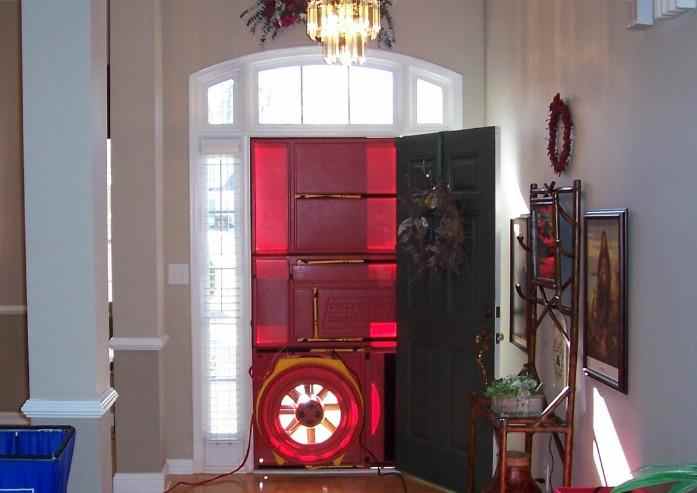
During the test, a calibrated fan is mounted in an exterior doorway and depressurizes the house. Outside air gets pulled in through every unsealed gap, measuring exactly how much outside air is leaking into your home, while a walkthrough locates exactly where the leaks are.
Remember, the draft sneaking through your baseboard in January is the same gap pulling wildfire smoke into that room in August. The same test finds it during either season. The timing of the test is also important. Ensure the blower door test and any sealing work are completed before smoke season starts and the air turns hazardous.
How Wildfire Smoke Gets Into a “Closed Up” House
Closing your windows and doors is the standard first step during a smoke event. Yet outdoor air and wildland fire smoke can still enter a closed home through infiltration. Small openings, joints, cracks, and gaps around closed windows and doors all let smoke in.
Staying indoors works better in some homes than others. A tighter home keeps much more smoke out. It also helps your HVAC filtration system and portable air purifiers work more effectively because they aren’t constantly fighting a stream of smoky outdoor air. In a leaky home, indoor particulate levels and air quality track outdoor conditions more closely. Your building envelope, not your front door, is the real boundary between your family and the smoke outside.

What to Do with the Results: Before Smoke Season
Step 1: Test first
Schedule your blower door test in spring or early summer. That gives you time to act on the results before July. Don’t wait until smoke is already in the air.
Step 2: Seal what it finds
The test data lets a contractor zero in on specific leaks with no guesswork. Air sealing is described by the U.S. Department of Energy as a cost-effective way to limit air leakage, cut heating and cooling costs, and create a healthier home environment. When you seal your home before wildfire season, you take back control of what gets in.
Step 3: Verify the improvement
A follow-up blower door reading after sealing quantifies exactly how much building envelope air leakage was reduced. The gain is measured, not assumed.
Step 4: Layer your defenses
A tighter home makes the rest of your smoke-season plan far more effective. Steps such as keeping your windows closed, putting your HVAC system on recirculate, running a HEPA portable air purifier, and setting up a clean air room for your Inland Northwest home, all work significantly better at maintaining your indoor air quality when your envelope has fewer gaps.
Frequently Asked Questions
Q: Does a blower door test help with wildfire smoke?
Q: When should I get a blower door test if I'm worried about smoke?
Q: Why does smoke get into my house even with the windows closed?
Q: Is this the same blower door test used for energy efficiency?
Q: Will sealing my home keep all the smoke out?
Ready to Breathe Easier This Summer?
In the Inland Northwest, the blower door test has become a two-season tool. Wildfire smoke is a harmful mix of gases and fine particulates, and recent seasons have repeatedly pushed Inland Northwest wildfire smoke levels into unhealthy ranges. Winter comfort and summer air quality both depend on the same thing: a well-sealed building envelope that limits unwanted air leakage. Take the time to get the test done and act on what it finds before smoke season starts.
Specialty Group performs blower door testing and air sealing for homeowners across Liberty Lake, Spokane, Coeur d’Alene, and the wider Inland Northwest. Our specialty environmental team brings expertise in both building performance and environmental health, so you get more than a number; you get a clear plan for what to do next. Contact us today to schedule your assessment before the smoke arrives.
U.S. Department of Energy. “Air Sealing Your Home.” Energy Saver, Office of Energy Efficiency & Renewable Energy, www.energy.gov/energysaver/air-sealing-your-home.
U.S. Department of Energy. “Blower Door Tests.” Energy Saver, Office of Energy Efficiency & Renewable Energy, www.energy.gov/energysaver/blower-door-tests.
U.S. Department of Energy. “Detecting Air Leaks.” Energy Saver, Office of Energy Efficiency & Renewable Energy, www.energy.gov/energysaver/detecting-air-leaks.
U.S. Environmental Protection Agency. “Strategies to Reduce Exposure Indoors.” Wildfire Smoke Course, EPA, www.epa.gov/wildfire-smoke-course/strategies-reduce-exposure-indoors.
U.S. Environmental Protection Agency. “Wildfires and Indoor Air Quality (IAQ).” EPA, www.epa.gov/emergencies-iaq/wildfires-and-indoor-air-quality-iaq.
U.S. Environmental Protection Agency. “Wildland Fire Research: Reducing Exposures.” EPA, www.epa.gov/air-research/wildland-fire-research-reducing-exposures.
Washington State Department of Ecology. “Wildfire Smoke.” Washington State Department of Ecology, https://ecology.wa.gov/air-climate/air-quality/smoke-fire/wildfire-smoke.
Washington State Department of Health. “Smoke From Fires.” Washington State Department of Health, https://doh.wa.gov/community-and-environment/air-quality/smoke-fires.
Washington State University Environmental Health & Safety. “Wildfire Smoke.” Washington State University, https://ehs.wsu.edu/wildfiresmoke-2/.