Every year, our Washington wildfire season seems to last longer. Smoke drifts across the state, pushing the air quality index into unhealthy levels. Many homeowners assume that once their doors and windows are closed, they’re safe inside.
The problem is that smoke doesn’t stay outside. It seeps in through cracks, gaps, and ventilation systems. It circulates through ductwork and settles into fabrics and insulation. It carries fine particulate matter (PM2.5) that can pose serious health risks, including triggering respiratory problems and worsening heart or lung conditions.
The Environmental Protection Agency (EPA) confirms that during wildfire events, indoor PM2.5 levels are usually lower than outside levels, but still much higher than on normal non-smoke days. That means your home is not automatically a safe haven. This is an even greater risk in older or poorly sealed homes.
The Washington State Department of Health identifies wildfire smoke as a growing health risk, especially in summer and early fall. Homeowners are encouraged to protect their homes by sealing entry points, upgrading filtration, and using portable air purifiers.
Not sure how smoke-ready your home is? A professional indoor air quality test can uncover vulnerabilities you may not see and identify hidden gaps and filtration issues before wildfire season arrives.
How Wildfire Smoke Gets Inside Your Home
Common Entry Points
Smoke particles are extremely small. Even when your home looks tightly sealed, air can leak in through:
- Gaps around windows and doors
- Cracks in foundations and exterior walls
- Openings around plumbing, wiring, and ductwork
- HVAC systems pulling in outdoor air
That is why air sealing smoke infiltration becomes critical. Reducing air leakage improves your home’s comfort and creates a healthier indoor environment.
Why Washington Homes Are Especially Vulnerable
Wildfire smoke events in Washington often start in July or August, but can begin as early as May. They can last days or even weeks. Older homes in eastern Washington are especially vulnerable to smoke infiltration from these fires due to aging materials and inadequate air sealing.
Fine particulate matter, known as PM2.5, is small enough to travel through these gaps. This increases PM2.5 indoor exposure, even when you stay indoors.

Reducing smoke infiltration starts with tightening your home’s building envelope. Consider professional air sealing services to target those hidden gaps and provide smoke infiltration prevention.
Health Risks of Wildfire Smoke Indoors
What’s in Wildfire Smoke?
Wildfire smoke is a mix of gases and fine particles. It commonly contains:
- PM2.5 (fine particulate matter)
- Carbon monoxide
- Volatile organic compounds (VOCs)
- Polycyclic aromatic hydrocarbons (PAHs)
PM2.5 is the biggest concern. These particles are small enough to penetrate deep into your lungs and even enter your bloodstream, causing serious health effects.
Who Is Most at Risk?
Children, adults over 65, pregnant women, and people with heart or lung diseases, such as asthma or COPD, face the highest risk from smoke exposure. Wildfire smoke can worsen existing conditions and may increase the risk of respiratory infections even weeks later.
These wildfire smoke health effects are not limited to outdoor exposure. Indoor exposure over several days can trigger coughing, headaches, throat irritation, and shortness of breath.
If your home already struggles with ventilation or pollutant buildup, smoke makes it worse. Improving your indoor air quality is the best way to protect those most at risk.
How to Protect Your Indoor Air During Wildfire Season
1. Seal Your Home’s Envelope
Start with weatherstripping your doors and windows. Use caulk or foam to seal gaps around plumbing, wiring, and duct penetrations.
Schedule a blower door test to measure air leakage and identify the most critical areas to seal. The Department of Energy recommends reducing your home’s air leakage as much as possible while providing controlled ventilation as needed to maintain indoor air quality.
2. Upgrade Your HVAC Filtration
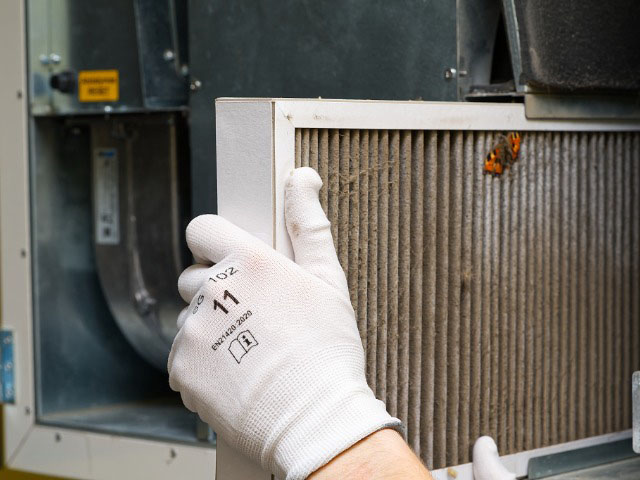
Your HVAC system plays a major role in indoor air quality protection. Install a MERV 13 filter, or the highest-rated filter your system can handle, to capture fine particles from wildfire smoke.
Replace filters more often during heavy smoke events. They clog faster when particulate levels are high. The Washington Department of Health recommends conducting a pre-wildfire season HVAC checkup to ensure your air filters are rated for particle removal and your equipment operates properly.
3. Use Portable Air Purifiers
Utilize a portable air purifier against wildfire smoke. Ensure that it has HEPA filters sized for the room and runs continuously during smoke events. Select a unit that does not produce ozone, such as the Aspen Air Purifier, which provides high-efficiency filtration for larger living spaces.
4. Create a Clean Air Room
Set up one clean air room with closed doors and windows and a HEPA purifier running. Avoid cooking, smoking, and other activities that generate particles in that space.
Spend as much time as you can in your clean air room during a wildfire smoke event for the greatest benefit.
When to Call a Professional
If you notice persistent smoke odors, visible indoor haze, or worsening respiratory symptoms even with your windows closed, your home likely has air leakage issues that require professional assessment.
Professional indoor air testing can identify elevated particle levels, ventilation problems, and hidden entry points for smoke infiltration. With this knowledge, you can ensure your home has proper sealing and filtration to protect you from future wildfire smoke events.
Protect Your Home Before Smoke Season Peaks
Wildfire smoke is becoming a regular part of life here in Washington. Waiting until the sky turns gray and the air quality index spikes is not a plan.
Protecting your indoor air quality requires a proactive approach that starts well before fire season. Combining air sealing, HVAC filtration upgrades, and portable air purification creates a layered defense that significantly reduces your indoor smoke exposure.
Specialty Group has been serving homeowners in Washington and the Inland Northwest for decades. Our locally owned team brings certified, licensed expertise in indoor air testing and whole-home air quality solutions. We help local homeowners identify hidden weaknesses and implement solutions to keep their indoor air cleaner during wildfire season and year-round.
Contact us today to schedule a blower door test or indoor air quality assessment for your Washington home.
FAQs
Q: Can wildfire smoke get inside your house with the windows closed?
A: Yes. Smoke enters through small gaps, utility penetrations, and HVAC systems, even when the windows are closed. Better sealing and filtration significantly reduce smoke exposure.
Q: What kind of air filter helps with wildfire smoke?
A: A MERV 13 or higher-rated filter is recommended for capturing fine smoke particles. Portable HEPA air purifiers provide added room-level protection.
Q: How do I know if wildfire smoke is affecting my indoor air?
A: Watch for coughing, eye irritation, throat discomfort, or visible haze indoors. Monitoring indoor particles with an indoor air quality monitor and scheduling professional testing will provide confirmation of pollutant levels and entry points.
Q: Does air sealing help keep wildfire smoke out?
A: Absolutely. Reducing uncontrolled air leakage with air sealing is one of the most effective steps towards smoke infiltration prevention and creating a healthier indoor environment.
References
Oregon State University Extension. (n.d.). Protecting indoor air from wildfire smoke (EM 9379). https://extension.oregonstate.edu/catalog/em-9379-protecting-indoor-air-wildfire-smoke
U.S. Department of Energy. (n.d.). Air sealing your home. Energy Saver. https://www.energy.gov/energysaver/air-sealing-your-home
U.S. Environmental Protection Agency. (n.d.). Create a clean room to protect indoor air quality during a wildfire. https://www.epa.gov/emergencies-iaq/create-clean-room-protect-indoor-air-quality-during-wildfire
U.S. Environmental Protection Agency. (n.d.). Strategies to reduce exposure indoors. Wildfire Smoke Course. https://www.epa.gov/wildfire-smoke-course/strategies-reduce-exposure-indoors
U.S. Environmental Protection Agency. (n.d.). Wildfires and indoor air quality (IAQ). https://www.epa.gov/emergencies-iaq/wildfires-and-indoor-air-quality-iaq
University of California, Berkeley. (2021, September 2). How much wildfire smoke is infiltrating our homes?https://www.universityofcalifornia.edu/news/how-much-wildfire-smoke-infiltrating-our-homes
Washington State Department of Ecology. (n.d.). Health effects from smoke. https://ecology.wa.gov/air-climate/air-quality/smoke-fire/health-effects
Washington State Department of Health. (n.d.). Smoke from fires. https://doh.wa.gov/community-and-environment/air-quality/smoke-fires
Washington State Department of Health. (n.d.). Improving ventilation and indoor air quality during wildfire smoke events [PDF]. https://doh.wa.gov/sites/default/files/legacy/Documents/Pubs//333-208.pdf